The Space Between
- Jan 26
- 2 min read
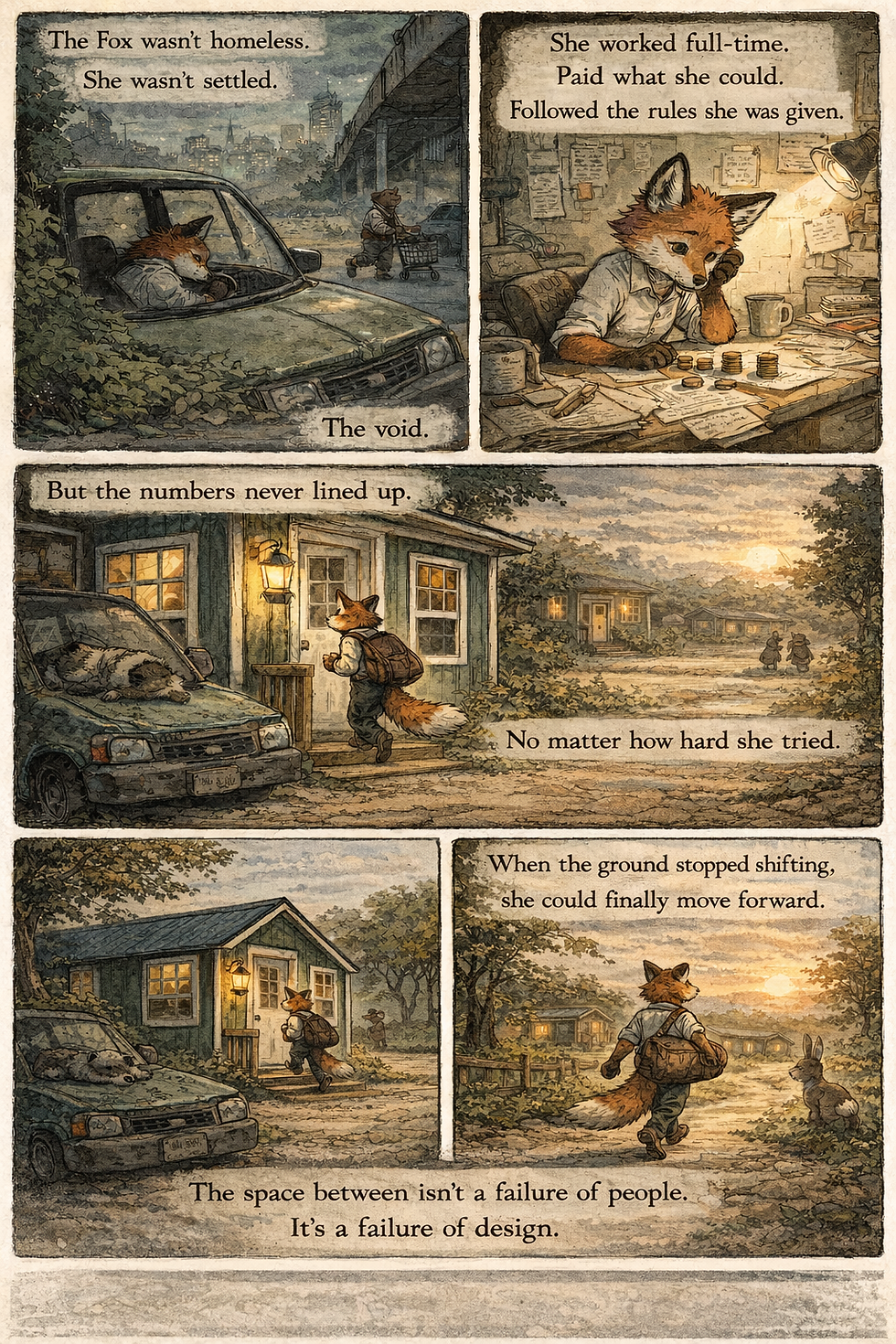
No one ever plans to live in the space between.
It’s not the street. It’s not a shelter. It’s not stability either.
It’s the void.
The place where people are doing everything they were told to do—working full-time, showing up, paying what they can—yet still can’t clear the final hurdle into permanence.
They aren’t homeless in the way systems recognize. They aren’t earning enough to qualify for most housing. They are fully employed, exhausted, and invisible.
Most systems don’t know what to do with people like this.
So they do nothing.
How People Get Stuck There
In the void, life becomes a math problem with no solution:
Rent increases faster than wages
Deposits stack on top of deposits
Credit takes hits just trying to survive
Time gets eaten by commuting, couch-surfing, parking lots, borrowed spaces
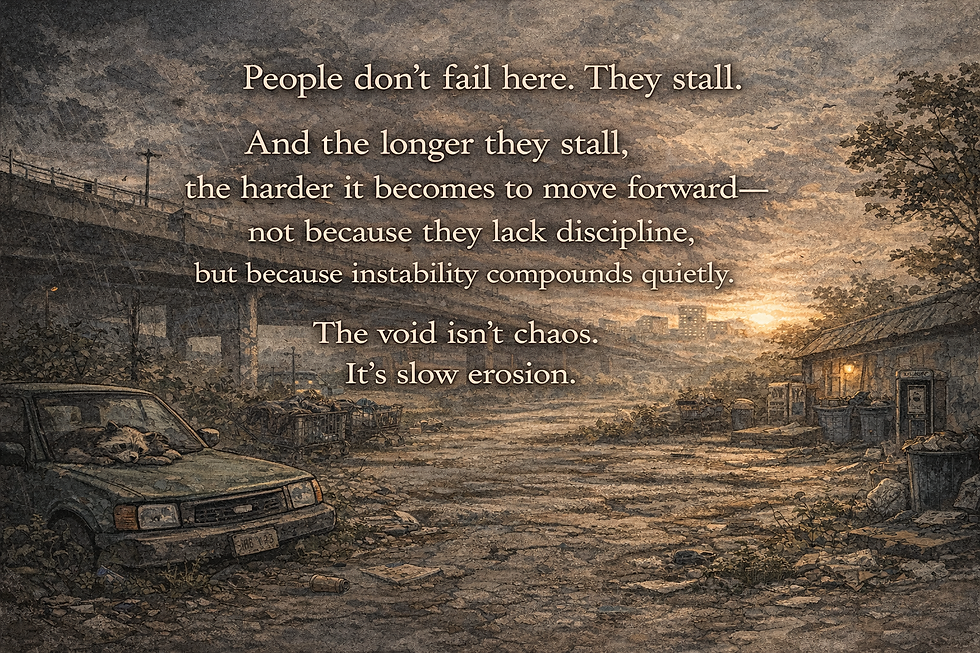
People don’t fail here. They stall.
And the longer they stall, the harder it becomes to move forward—not because they lack discipline, but because instability compounds quietly.
The void isn’t chaos. It’s slow erosion.
What Actually Helps (and What Doesn’t)
What doesn’t help:
Endless paperwork to prove you’re struggling “enough”
Programs designed for crisis, not recovery
Case management that treats adults like projects
Shame disguised as support
What does help is almost offensively simple.
A step.
Not a leap. Not a rescue. Not a lifetime commitment.
Just a solid, predictable place to stand.
The Stepstone Idea (as an Example, Not the Point)
Imagine housing that doesn’t ask people to collapse before it catches them.
A small, dignified home. Flat, predictable rent. A clear time horizon—long enough to breathe, short enough to keep momentum. No lectures. No hoops. No labels.
Not a “forever solution. ”A transition that actually transitions.
That’s what stepstone-style housing represents—not a brand, but a principle:
Stability first. Progress follows.
When people know where they’re sleeping, everything else starts lining up:
Savings reappear
Credit stops bleeding
Focus returns
Health improves
Decision-making gets clearer
Not because someone “fixed” them—but because the ground stopped moving.
How We Help People Find Their Way Out of the Void
We stop asking, “What’s wrong with you? ”And start asking, “What’s missing?”
For most people in the void, what’s missing isn’t effort, morals, or motivation.
It’s transitional infrastructure.
So better solutions look like:
Time-limited housing designed for working adults
Rent that doesn’t punish progress
Clear expectations instead of constant evaluation
Respect baked into the model, not added as a slogan
And most importantly: an exit path that’s visible from day one.

The Quiet Truth
People don’t need saving. They need traction.
When you give someone a step instead of a sermon, they climb on their own.
The void isn’t a personal failure. It’s a design failure.
And once we design for the missing middle—people don’t just get housed.
They get unstuck.